Pilates at Home, Effective Workouts

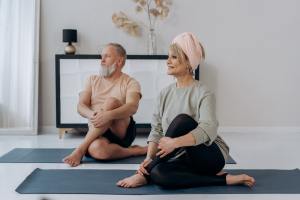
Pilates is a fantastic exercise method that can be easily practiced at home. It focuses on core strength, flexibility, and overall body conditioning. Here are some tips on how to exercise at home using Pilates:

  1. Set up a dedicated space: Find a quiet area in your home where you can spread out a mat or a soft surface to exercise. Ensure that you have enough space to move comfortably.
  2. Warm up: Before starting your Pilates routine, warm up your body with some gentle movements to prepare your muscles for the workout.
  3. Start with the basics: If you’re new to Pilates, it’s essential to begin with foundational exercises. Start with exercises that target your core, such as the Pilates Hundred (abdominal exercise), Pilates Roll-Up (spinal articulation), and Pilates Single Leg Stretch (abdominal strength and coordination).
  4. Follow instructions from a qualified teacher can guide you through various Pilates exercises, ensuring proper form and technique. Look for reputable instructors or platforms that suit your needs and skill level.
  5. Progress gradually: As you become more comfortable with the basic exercises, gradually increase the intensity and challenge of your Pilates routine. Add variations, increase the number of repetitions, or introduce props like resistance bands or Pilates balls to make your workouts more dynamic.
  6. Focus on proper form and alignment: Pilates emphasizes precise and controlled movements. Pay attention to your form, alignment, and breathing throughout each exercise. Engage your core muscles, lengthen your spine, and maintain a neutral posture.
  7. Mix it up: Keep your Pilates routine interesting and diverse by incorporating different exercises that target various muscle groups. Include exercises for the arms, legs, back, and glutes to achieve a balanced full-body workout.
  8. Listen to your body: As with any exercise program, it’s crucial to listen to your body and avoid overexertion or pushing yourself too hard. Take breaks when needed and modify exercises if you have any physical limitations or injuries.
  9. Cool down and stretch: After completing your Pilates session, cool down your body with gentle stretches. Focus on lengthening and stretching the muscles you worked during the workout.

Remember to consult with a healthcare professional or certified Pilates instructor if you have any pre-existing health conditions or concerns. They can provide personalized guidance and modifications based on your needs.
Wellbeing at Work

Organisations and their managers can play an important role in their employees health and lifestyle choices. This is important as it will impact the company and its performance. Physical and mental wellbeing includes health promotion where managers can encourage employees in many ways, such as healthy eating, good posture, prevention of back pain as well as encouraging relaxation techniques.

Establishing strategies for wellbeing by developing a programme of initiatives is a good starting place, looking at what the organisation already does and then considering the changes which need to be implemented.

Psychology of Marathon Running

SOFTV3-201904271131160132989

Participants competing in long endurance events such as the Marathon has steadily risen over the years.  Data taken of both demographic and socio-economic groups from various studies has seen a rise in running becoming a popular sport.

The Marathon runner embarks on this challenge for many reasons and they must adapt their lifestyle and training far beyond the recreational exerciser to include high levels of demanding physiological and psychological adaptations to push beyond their current capabilities.  Furthermore, the rewards and positive benefits of this training will outweigh the negatives of marathon running.

The London Marathon is my third marathon, as a veteran runner I have improved with age, both on personal performance together with a faster post marathon recovery rate.  Training for a Marathon demands a consistent, disciplined, structured routine which will manifest into other areas of the runners life to include; personal goal achievement, better life management, psychological and emotional strategies for coping and better vitality and health.

Camino & Resilience

pexels-photo-562623

The route continued to Palas De Rei. After leaving Portomarin, crossing the River Mino we continued uphill steadily through woodland, the rain continued and got heavier and heavier. Continuing through small hamlets, passing the Hospital de la Cruz. Arriving at Vendas de Naron to get a ‘pilgrim stamp’ the old Romanesque Chapel, then continuing along the paved path, arriving at Sierra de Ligonde which offered fantastic views over the valleys. Particular parts of the route were isolated and quiet, apart from a rather large dog. The fog was dense and we were soaked through.

Approaching A Calzada the weather was so bad, we took shelter under a tree. There were other walkers, one an Australian man, we had met further back in other towns.  After discussing the weather, our blisters, stories of one walker getting frostbite back in the Pyrenees, our conversation compared the weather to life and the Camino, there are good and bad times, but we must press forwards.

The Camino de Santiago builds resilience, both emotionally and physically, it enables us to develop a positive mind and can-do-attitude.  We can integrate resilience into our lives on a daily basis, by being more active, getting more sleep and eating well, forgiving ourselves and resolving conflict. These small steps can help us improve our mental health and to face everyday challenges.